
Self-Assessment
Self-assessment enables students to check how well they have understood the material and to evaluate the outcomes of their own learning. It


Criterion-referenced assessment is based on clearly defined descriptive criteria that relate directly to learning outcomes. Each criterion specifies what is being assessed and describes what performance looks like at different levels. As a result, students can understand what is expected of them, how to plan their work, and what decisions to make while completing a task. The focus of this approach is the quality of the outcomes achieved. Teachers assess observable and demonstrable evidence of learning, such as subject knowledge, the application of methods, the appropriateness of solutions, and the quality of argumentation. This makes it possible to move away from comparing students with one another and instead base assessment on clearly defined standards of quality.
It is also important to recognise what is deliberately excluded from assessment. Criterion-referenced assessment does not take into account declared effort, motivation, or personal characteristics, as these are not objective indicators of the achievement of learning outcomes. This perspective strengthens the sense of fairness and directs students’ attention towards the development of competencies.
Rubrics primarily serve an orientational and regulatory function. They help students understand their current stage of development and what is required to achieve a higher level of competency. In this way, assessment becomes a tool that supports reflection and decision-making throughout the learning process.
The starting point for designing criteria is the aim of the course and the intended learning outcomes. Criteria should directly reflect what students are expected to achieve, and their descriptions should refer to observable outcomes. Linguistic consistency between the course aims, learning outcomes, and criteria makes it easier to understand how students’ actions contribute to achieving the intended outcomes.
Effective criteria distinguish between levels of competence in a clear and unambiguous way. Each level refers to the same elements while showing differences in the depth of analysis, appropriateness of solutions, independence, or coherence of argumentation. Descriptions should indicate performance rather than judgement; therefore, instead of using general evaluative terms, they should describe specific actions and the quality with which they are performed.
It is also important to align the criteria with a learning outcome. For knowledge-related outcomes, criteria refer to the accuracy and understanding of concepts. For skills, they focus on the quality of applying methods and the appropriateness of solutions. For social competences, they include observable behaviours such as collaboration and responsibility for completing a task.
Well-designed criteria are shared with students from the beginning of their work on a task. In this way, they serve as a guide that structures the learning process and enables students to manage the quality of their own work consciously.
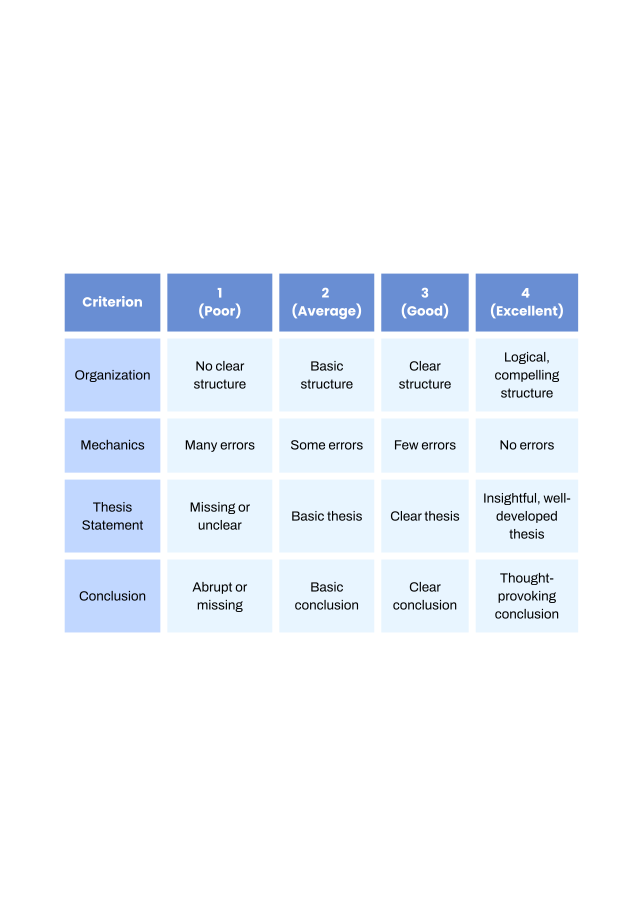
One of the most common mistakes is failing to align assessment criteria with learning outcomes. In such cases, a rubric becomes a set of the teacher’s intuitive expectations rather than a tool for evaluating students’ actual achievements. A similar problem arises when course aims are too general and therefore do not provide a meaningful reference point for assessment.
Another common difficulty is the use of vague descriptions of performance levels. Phrases such as “very good” do not explain what actually differentiates the quality of work. As a result, students may not understand what they need to do differently in order to achieve a higher level. It is also problematic when levels describe different elements rather than different degrees of quality within the same criteria. Such a structure makes levels difficult to compare and reduces the value of feedback. Similarly, an unclear progression between levels can make assessment less transparent.
In practice, rubrics are sometimes treated solely as tools for awarding points. In these situations, students may focus on obtaining grades rather than understanding the quality of their work. It is equally limiting when criteria are introduced only after the final grade has been awarded, as this prevents students from using them as part of the learning process.
The consequence of these mistakes is the loss of the developmental function of assessment. Assessment then becomes unclear and may be perceived as arbitrary. Well-designed criteria help to structure the assessment process, increase transparency, and strengthen students’ responsibility for the quality of the outcomes they achieve.
Self-assessment enables students to check how well they have understood the material and to evaluate the outcomes of their own learning. It

Peer review is an instructional and assessment strategy in which students evaluate and provide feedback on one another’s work according to clearly defined criteria and rubrics.

Summative and formative assessment are both essential for effective learning, whether in traditional or online education.