Self-Assessment
Self-assessment enables students to check how well they have understood the material and to evaluate the outcomes of their own learning. It


With easy access to large language models that can generate text, the question of whether students wrote a piece of work entirely on their own is no longer the central issue. What matters more is whether they understand what they have submitted and can discuss it critically.
In practice, this means shifting attention from the final product to students’ understanding and the process behind their work. One simple solution is to introduce a short defence.
A brief conversation or presentation can quickly show whether students understand their arguments, can justify them, and can respond to questions. A short test based on the submitted work can serve a similar purpose by checking students’ knowledge of its structure, logic, and sources. Students can also be asked to explain one section in simple language or apply one of their conclusions in a different context. This helps show whether they genuinely understand their own work. It is also worth asking for evidence of the process. Drafts, working versions, notes, or comments in the document can reveal how students thought and made decisions. Because these are difficult to recreate artificially, they can provide useful evidence of engagement and independent work. Author commentaries are another valuable addition. They allow students to explain why they chose particular solutions and how they reached their conclusions. For larger assignments, a short in-class stage can also be included, allowing the teacher to observe how students work towards the final version.
AI can significantly reduce teachers’ assessment workload, especially when tasks are repetitive. It can help organise the process and make it faster.
Firstly, AI can help prepare initial feedback on students’ work. Using assessment criteria or a rubric, it can generate comments on structure, argumentation, or style. The teacher remains responsible for the final judgement, but the time spent on each assignment can be reduced. AI-generated feedback should always be treated as a draft that needs to be checked, expanded, and refined.
AI can also be useful when analysing larger sets of assignments. It can help identify recurring mistakes, common misunderstandings, or gaps in understanding, making it easier to plan future classes. In this way, assessment becomes a source of information about the whole group, not only individual students.
Chatbots and large language models can also support the design of tests, open-ended questions, and alternative versions of tasks. This can make assignments less predictable and reduce the likelihood of students producing generic or mechanical answers. AI can also help with the quick checking of simple tasks, quizzes, or items with clear, unambiguous answers.
Another useful strategy is to ask AI to prepare an example answer that contains errors. Students can then analyse it as “error detectives”, identifying gaps and inaccuracies and explaining how they know that a given answer is incorrect.
AI is best treated as an assistant that helps organise work, prepare materials, and analyse data, while key decisions remain with the teacher. However, AI cannot support every aspect of assessment. The greatest developmental value still lies in assessing the quality of students’ thinking, and this cannot be fully automated.
When AI tools are widely available, unclear rules can easily lead to misunderstandings and a sense of unfairness. Students need to know what is allowed, what is expected of them, and how their work will be assessed.
The first step is to clearly define how AI may be used. It helps to name specific areas, such as generating ideas, editing text, or analysing data, while also making clear where independent work is required.
One useful option is to ask students to include a short statement explaining how they used AI tools. This should describe their own contribution, the changes they made, and any AI suggestions they chose not to use.
It is also worth introducing a scale of AI use to make expectations clearer. Such a scale can describe different levels of acceptable use, from fully independent work to using AI for generating ideas or improving clarity, while making clear that key decisions, judgement, and responsibility remain with the student. A clear framework helps students understand what is acceptable and supports greater transparency and fairness in assessment.
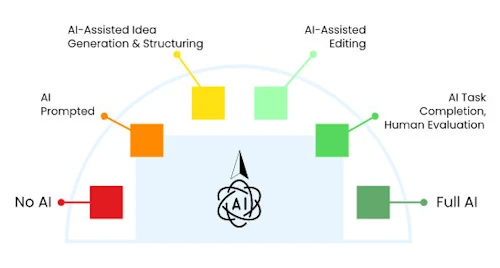
https://leonfurze.com/2023/12/18/the-ai-assessment-scale-version-2/
Another important element is clear assessment criteria. Students should know whether they are being assessed on their understanding, argumentation, working process, use of sources, or reflection. The more specific the criteria are, the fairer the assessment feels and the less room there is for uncertainty. It should also be clear from the start whether only the final product will be assessed, or whether the process of reaching the solution will count too. The rules should be explained at the beginning of the course and applied consistently. Changes during the semester, or unclear communication, can weaken students’ trust in the teacher and reduce their motivation.
Everything you need to run this method next week in your classroom.
Self-assessment enables students to check how well they have understood the material and to evaluate the outcomes of their own learning. It

Peer review is an instructional and assessment strategy in which students evaluate and provide feedback on one another’s work according to clearly defined criteria and rubrics.
Criterion-referenced assessment is based on clearly defined descriptive criteria that relate directly to learning outcomes. Each criterion specifies what is being assessed and describes what performance looks like at different levels.