Decision Lab
Decision Lab is structured around making a collective decision in a situation where there is no single obvious answer and the available information is incomplete, contradictory, or ambiguous.

Tools: a timer, a list of questions or topics, and optionally question cards
Best for: group integration, exchanging perspectives, collecting ideas quickly and encouraging student participation

Speed Networking consists of short, rotating pair conversations in which students respond to specific questions or complete mini tasks. Each conversation lasts from one to several minutes, after which students change partners. This allows every student to interact with several people in a short time and encounter different ways of thinking.
The key features are pace and a strict time limit. Short rounds encourage students to for- mulate their thoughts quickly, select the most important information and get straight to the point. There is little room for long introductions or vague generalisations, which makes the activity more dynamic and engaging.
It works particularly well at the beginning of a class, when you want to activate the group, lower barriers and introduce a topic through interaction. It can also be used during a class to gather different perspectives or collect many ideas in a short time.
However, be careful not to turn it into a series of superficial conversations without a clear purpose. If the questions are too general or do not require real thinking, students quickly lose engagement. Each question should lead to something specific, such as a decision, justification or reflection.
Speed Networking can take different forms. You can use open-ended questions, mini case studies, decision-making dilemmas or short tasks that require students to make and justify choices. You can also introduce a sequence of questions in which each new round explores the topic in greater depth.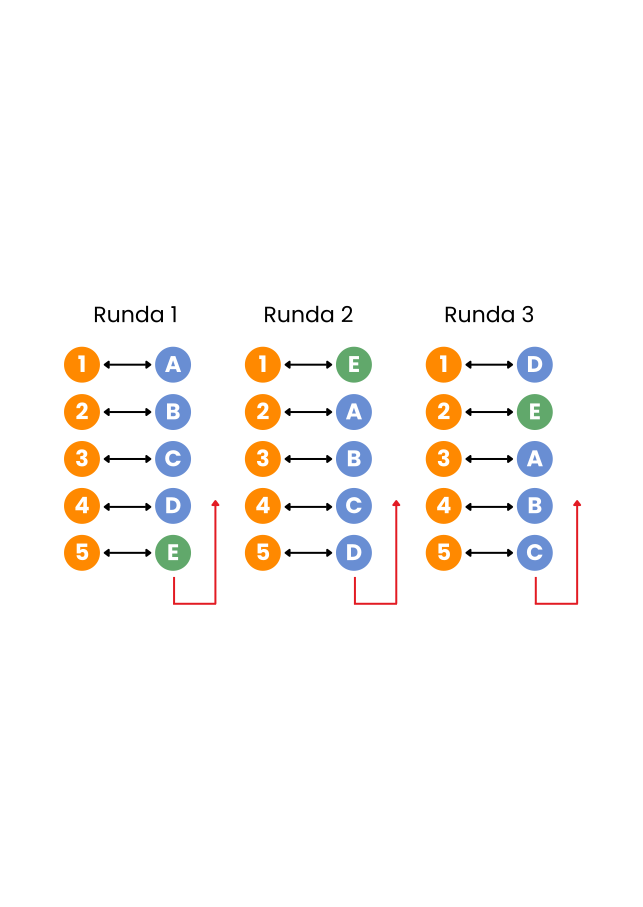
Course: Marketing
Topic: Customer Segmentation
Students work to understand how different segmentation criteria influence marketing decisions.
Introduction (5 min)
The teacher introduces the topic of segmentation and explains that students will analyse different ways of dividing a market and the consequences of those choices. Each student receives a short question or mini task related to the topic.
Conversation Rounds (5–20 min)
Students work in pairs, answering questions such as identifying potential customer segments, choosing the most important segmentation criterion or justifying a marketing decision. After each round, students change partners, allowing them to compare their ideas with others. In later rounds, the questions become more demanding and build on earlier answers.
Collecting Conclusions (5–15 min)
After the rounds, the teacher gathers the key conclusions. Students identify which ideas appeared most often and which were the most surprising or convincing.
Reflection (5 min)
Students reflect on how their answers changed during the conversations and which arguments influenced their thinking.
Easier → Give simple questions and allow more time for discussion.
More Challenging → Use shorter rounds, more complex problems, and require students to justify their decisions.
Formative Assessment
After several rounds of conversation, the teacher asks students to record one idea they heard from their partner and one question that helped deepen the discussion. Based on these reflections, the teacher provides brief developmental feedback. Students use this feedback in the next round to express their ideas more precisely and respond more effectively to their conversation partners.
Summative Assessment
Assessment may focus on a short reflective summary completed at the end of the activity. Students identify the most important insight gained from the conversations, one perspective that changed or broadened their thinking, and their own position on the issue discussed. Assessment criteria may include the clarity of the conclusion, reference to the contributions of others, the ability to synthesise ideas, and the reflective use of different perspectives.
Decision Lab is structured around making a collective decision in a situation where there is no single obvious answer and the available information is incomplete, contradictory, or ambiguous.

World Café involves several parallel discussions at different tables, focused on one topic or a set of related questions. Students work in small groups and then rotate between tables, developing and building on ideas from previous groups.

Peer learning is based on the assumption that teaching others is one of the most effective ways of learning.