Hackathons and Sprints
A hackathon or innovation sprint is an intensive, clearly structured form of teamwork focused on a single challenge, carried out within a limited timeframe and according to previously agreed criteria.

Tools: empathy maps, sticky notes, Miro / Mural, paper prototypes, storyboards
Best for: solving user problems, designing services and user experiences, and developing creativity and teamwork skills

Design Thinking is an approach to problem-solving that guides students from understanding the user to testing solutions in conditions that closely resemble real life. Its key principle is to reverse the typical logic of classroom work: instead of starting with developing ideas, the process begins with analysing the experiences, needs and constraints of the target user.
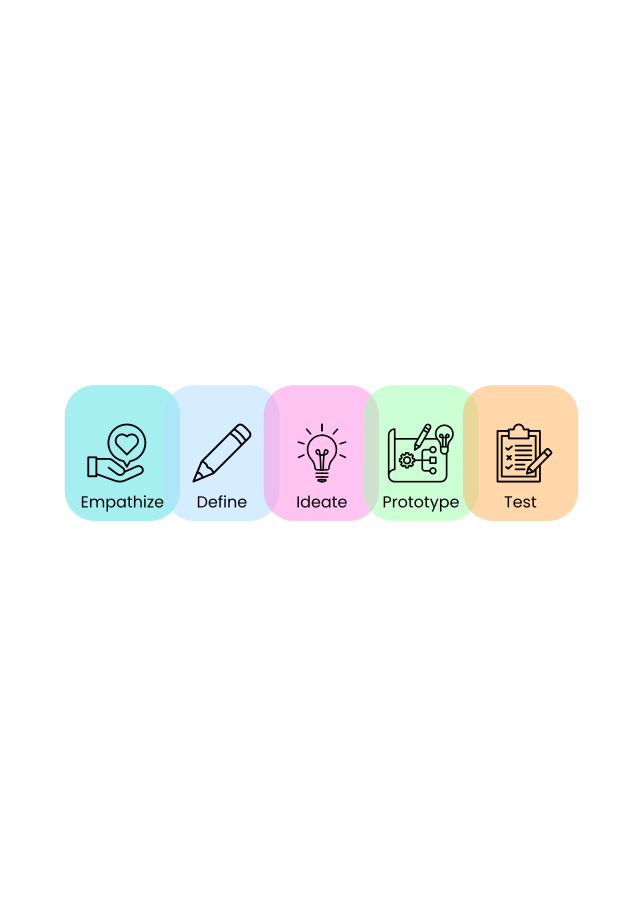
The classic process consists of five stages: empathising, defining the problem, developing ideas, prototyping and testing. In practice, this means that students first gather data, for example through interviews, observations or analysis of user experiences. They then formulate a clear design challenge and only afterwards move on to developing solutions.
Rapid prototyping plays a central role in the process. Rather than trying to perfect a concept from the beginning, students create a simplified version that can be tested, evaluated and improved through iteration.
However, Design Thinking is often applied superficially. It may be reduced to creative idea development or visually attractive solution design without deeper user analysis or meaningful testing. In such cases, it loses much of its educational value and becomes little more than a well-packaged brainstorming exercise.
Course: Services Marketing
Topic: Improving the User Experience
Students work in teams to improve one of the key university processes – course registration. The aim is to design a solution that reduces the number of errors, shortens decision-making time, and improves the user experience.
Introduction (5-10 min)
The teacher presents the context: the current course registration system is unintuitive for students, causing stress and errors. The task for the teams is to design a solution that genuinely improves this experience.
Stage 1 – Empathy (30–45 min)
Students analyse user experiences based on short interviews, either within the group or using prepared scenario descriptions. They create an empathy map, identifying needs, frustrations and critical moments in the process.
Stage 2 – Problem Definition (20–30 min)
Teams formulate a precise design challenge based on the data collected and insights from the empathy stage. The key step is to move from a general problem to a specific user situation embedded in context.
Stage 3 – Developing Ideas (30–45 min)
Teams create a range of possible solutions, at least 10–15, deliberately separating idea devel-
opment from evaluation.
Stage 4 – Prototyping (45–60 min)
Students select one solution based on previously agreed criteria, such as fit with user needs, feasibility, potential impact and ease of rapid testing. They then create a simplified version, for example an interface sketch, process map or user journey.
Stage 5 – Testing (30 min)
Other teams take on the role of users and test the solutions. The authors collect feedback and identify elements that need improvement.
Iteration and Reflection (20–30 min)
Teams revise their solutions based on feedback and reflect on what worked, what did not, and what should be improved in the next version.
Easier → Provide a ready-made problem, personas, a description of the user situation, and a simple template for each stage of the process.
More Challenging → Introduce real users or stakeholders, require prototype testing, solution revision based on feedback, and justification of design decisions using the data collected.
Formative Assessment
Provide brief feedback after each stage and observe how the teams work throughout the process.
Summative Assessment
Assess the quality of the solution, the justification of decisions, the clarity of the presentation, and the coherence of the overall process.
A hackathon or innovation sprint is an intensive, clearly structured form of teamwork focused on a single challenge, carried out within a limited timeframe and according to previously agreed criteria.

A creative e-portfolio involves the systematic documentation of a student’s work. Each entry should show what was done, why particular decisions were made, and what consequences they had
A Fab Lab is a learning environment based on making, experimentation, and working with physical prototypes.