
Creative Summary
In a creative summary, students explain a selected topic clearly and accessibly to an audience outside the field.

Tools: whiteboard, sheets of paper, sticky notes, or online tools (e.g. Miro, Mural, Padlet), and optionally an argument mapping template
Best for: organising arguments, analysing problems, preparing for debates or writing tasks (e.g. essays or reports), and developing critical thinking skills

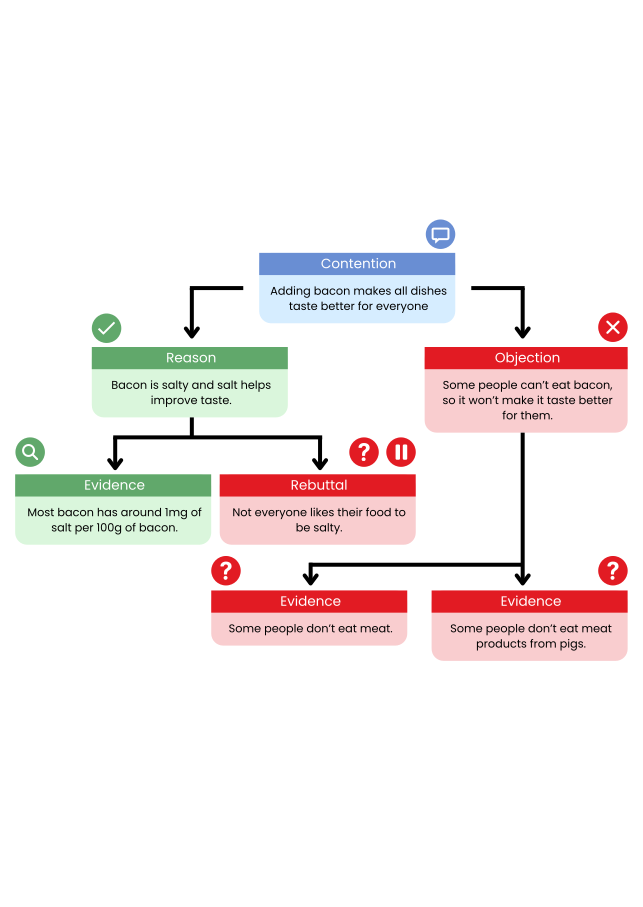
Argument mapping involves visually representing the structure of reasoning surrounding a particular problem or question. It helps students organise complex issues and understand how individual arguments relate to one another. As a result of the analysis, students create a structure presenting the main claim, supporting arguments, counterarguments, and the relationships between them.
The method develops critical and analytical thinking, teaches students to distinguish opinions from arguments, and demonstrates how to construct a logical line of reasoning. It is particularly useful when working with complex, multi-faceted, and controversial topics. It can also serve as a preparatory stage for a debate, essay, or decision-making task, helping students organise their thinking before moving on to more advanced forms of work.
Course: Business Strategy
Topic: Marketplace Model
Students analyse a strategic transformation decision: the shift from a traditional business model to a platform-based model. Instead of producing a simple list of arguments, they create an advanced argument map that includes weights, dependencies, and risks.
Introduction (5 min)
The teacher presents the context: a company is considering a transformation towards a digital platform model, such as a marketplace. The decision involves significant risk, but also considerable growth potential.
Defining the Claim and Criteria (10 min)
Teams define the main claim, for example: The company should transform its business model into a platform-based model within two years. They then establish decision-making criteria, such as:
• revenue potential
• operational risk
• implementation costs
• impact on customers
• competitive advantage
Building the Map (20 min)
Students create an argument map using a more advanced structure:
• Level 1: Main claim
• Level 2: Arguments for and against, linked to specific criteria
• Level 3: Evidence and data, such as reports, company examples, and numerical indicators
• Level 4: Counterarguments and risks
In addition, students assign weights to arguments, for example on a scale from 1 to 5, indicating their importance in the decision-making process. They also assess the level of data uncertainty, such as high or low certainty, and connect arguments with arrows to illustrate relationships and dependencies between them.
Decision and Justification (10 min)
Teams decide and justify it based on the weight of the arguments, the quality of the available data, and the analysis of risks.
Comparing Approaches (15 min)
Groups present their maps, while the teacher moderates a discussion showing that the same data may lead to different decisions and that the assumptions adopted, as well as the way they are interpreted, play a crucial role.
Easier → Provide the claim, the structure of the map, and sample arguments. Limit the number of elements (e.g. 2–3 arguments for and against).
More Challenging → Ask students to define the problem independently and to design and justify the entire structure of the argument map.
Formative Assessment
The teacher reviews a draft version of the argument map, including the main claim, supporting arguments, evidence, counterarguments, and the connections between them. Developmental feedback is provided by identifying which elements are logically linked, where additional evidence or justification is needed, and which relationships require further clarification. Students use the feedback to improve the structure of the map, strengthen the evidence base, and refine their final conclusion.
Summative Assessment
Assessment focuses on the final argument map together with a brief justification of the decision or position taken. Assessment criteria include the clarity of the main claim, the relevance of the arguments, the use of evidence, consideration of counterarguments, the logic of the connections between elements, and the quality of the final conclusion.
In a creative summary, students explain a selected topic clearly and accessibly to an audience outside the field.

A debate teaches students to think in the context of differing viewpoints. It helps them understand that a strong position requires justification, defence, and a willingness to revise one’s views in response to stronger arguments.

Students prepare a research paper or popular science article in a format similar to the editorial workflow of a journal.